Malaysia’s Energy Efficiency and Conservation Act (EECA) 2024 has introduced a broader framework for managing energy efficiency and conservation. For industrial facilities with significant energy consumption, this makes systematic energy management increasingly important.
Industrial heating systems can form part of this picture. Boilers, furnaces, dryers and other thermal systems may consume significant amounts of energy in some facilities. As a result, their performance may need to be reviewed as part of a wider energy-efficiency strategy.
What Is EECA 2024 in Malaysia?
The Energy Efficiency and Conservation Act 2024 is Malaysia’s legislation for regulating efficient energy consumption and conservation. It came into force on 1 January 2025 and applies in Peninsular Malaysia and the Federal Territory of Labuan.
The Act covers several areas, including energy consumers, certain buildings and energy-using products. For industrial businesses, one important area is the management and review of facility energy consumption.
More information about the legislation is available from the Energy Commission (Suruhanjaya Tenaga).
Which Industrial Energy Consumers Are Affected by EECA?
Not every Malaysian factory automatically has the same obligations under EECA.
According to the Energy Commission, the energy-consumer requirements apply when energy usage equals or exceeds 21,600 GJ over 12 consecutive months.
The Energy Commission identifies energy consumers that meet the prescribed threshold and issues the relevant notice. Therefore, facilities should first understand their energy consumption and whether the requirements apply to them.
What Does EECA Require From Affected Energy Consumers?
For energy consumers that meet the prescribed threshold, EECA involves more than simply replacing equipment with newer or more efficient models.
The Energy Commission lists several key obligations:
- Appoint a Registered Energy Manager (REM) to support the facility’s energy management responsibilities.
- Develop and implement an Energy Management System (EnMS) in accordance with the Energy Commission’s guidelines.
- Submit Energy Efficiency and Conservation (EE&C) reports covering energy management and consumption.
- Conduct energy audits through a Registered Energy Auditor (REA) and submit the required audit reports.
This means EECA should be viewed as a broader energy-management framework rather than a requirement to install one particular type of equipment.
Where Do Industrial Heating Systems Fit Into Energy Efficiency?
For facilities that rely heavily on process heating, thermal systems can be an important part of overall energy performance.
The Energy Commission’s energy-audit guidance covers electrical and thermal systems where applicable. Examples of thermal systems identified in its guidance include boiler systems, dryers, industrial furnaces, steam systems, thermal oil heaters and heat pumps.
Therefore, facilities using boilers and other combustion-based heating equipment may need to understand how efficiently these systems operate, particularly when they represent a significant share of facility energy consumption.
How Can Burner Performance Affect Industrial Energy Use?
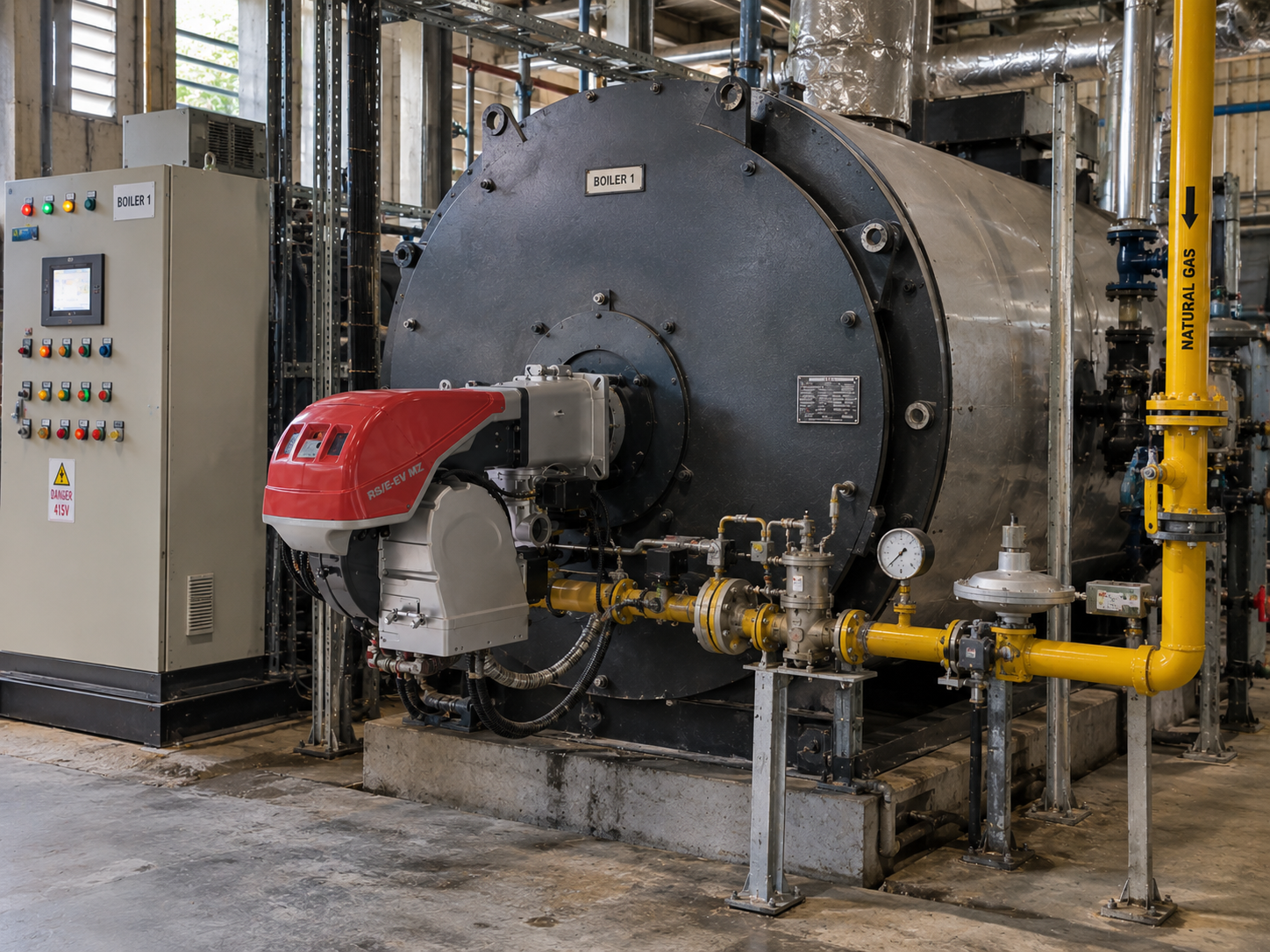
The burner is an important part of many industrial heating systems because it controls the combustion process used to generate heat.
Its performance can influence fuel use, combustion stability and the overall operation of the heating system.
Air-to-Fuel Ratio
Combustion requires the correct relationship between fuel and air. Poor combustion settings can contribute to inefficient fuel use and other operating problems.
The Energy Commission’s energy-audit guidance identifies fuel and air use and the air-fuel ratio among the measurements that may be reviewed for industrial furnace systems.
Burner Modulation
Industrial heat demand is not always constant. A burner with suitable modulation controls can adjust its firing output according to changing demand rather than operating at the same output continuously.
The potential efficiency benefit depends on the burner, heating system, control configuration and operating load.
Combustion Air Fan Control
Some burner systems use controls such as variable speed drives to adjust combustion-air fan speed according to operating demand.
Where suitable, this may help reduce unnecessary auxiliary electricity consumption during lower-load operation.
However, the appropriate solution should be determined from the actual operating condition of the system rather than assuming that every facility requires the same upgrade.
Does Installing a High-Efficiency Burner Make a Facility EECA-Compliant?
No. Installing a high-efficiency burner by itself does not establish EECA compliance.
For affected energy consumers, EECA includes broader requirements involving energy management, reporting and energy audits.
A burner or combustion-system improvement may instead form part of a wider energy-efficiency programme when the system is identified as an area for improvement.
This distinction is important. Facilities should assess their overall energy use and follow the applicable Energy Commission requirements rather than treating a single equipment upgrade as a complete compliance solution.
When Should a Facility Review Its Burner System?
A burner system may be worth reviewing when a facility experiences changing operating conditions or identifies opportunities to improve its heating performance.
Possible reasons for a review include:
- Increasing or unusually high fuel consumption
- Unstable combustion performance
- Poor burner response to changing heating demand
- Frequent burner maintenance requirements
- Ageing combustion controls
- Energy-audit findings related to the heating system
A review does not automatically mean the entire burner must be replaced.
Depending on the system, the appropriate action could involve maintenance, combustion tuning, control improvements, retrofitting or equipment replacement.
Supporting Industrial Heating Efficiency With Unimech
Industrial heating requirements vary according to the process, fuel source, operating load and existing equipment.
Facilities reviewing their heating systems should therefore consider the complete operating requirement rather than selecting a burner based on capacity alone.
Unimech provides industrial burner solutions for different heating applications. Facilities can also explore Unimech’s industrial boiler systems when reviewing broader steam and thermal requirements.
For a specific application, the existing system and operating requirements should be evaluated before deciding whether maintenance, optimisation, retrofitting or replacement is appropriate.
Conclusion: EECA and Industrial Heating Efficiency
EECA 2024 places greater emphasis on systematic energy management for affected energy consumers in Malaysia.
For facilities with energy-intensive thermal processes, boilers, burners and other heating systems may form part of the wider energy-efficiency review.
However, burner efficiency should not be treated as a stand-alone route to EECA compliance. The better approach is to understand the facility’s energy consumption, follow the applicable Energy Commission requirements and identify suitable improvements based on actual system performance.
Businesses reviewing their industrial heating requirements can contact Unimech to discuss suitable burner and boiler solutions for their application.
Frequently Asked Questions
What is EECA 2024 in Malaysia?
EECA 2024 is Malaysia’s Energy Efficiency and Conservation Act. It establishes a legal framework for energy efficiency and conservation and came into force on 1 January 2025.
Which energy consumers are affected by EECA 2024?
According to the Energy Commission, the energy-consumer requirements apply when energy usage equals or exceeds 21,600 GJ over 12 consecutive months.
Does EECA require companies to replace their industrial burners?
The Energy Commission’s published energy-consumer obligations focus on energy management, reporting and energy audits. They do not establish a general requirement for industrial facilities to replace their burners.
Can burner efficiency be part of an EECA energy-efficiency strategy?
Yes, where relevant. Energy audits can cover thermal systems, particularly when they contribute significantly to facility energy consumption.
Burner performance may therefore be relevant when reviewing a combustion-based heating system.
Does installing an efficient gas burner guarantee EECA compliance?
No. Burner efficiency is only one possible part of industrial energy performance. Affected energy consumers have broader EECA obligations involving energy management, reporting and energy audits.